Dr. Nagasuresh Enjamuri

 nagasureshppisr.res.in

- • 2024-Present: Assistant Professor, Materials Science and Catalysis, Poornaprajna Institute of Scientific Research (PPISR), Bengaluru, India.
- 2022-2023: Postdoctoral Research Fellow, Laboratory of Chemical System & Engineering, Hokkaido University, Sapporo, Japan.
- 2019-2022: Research Associate, Catalysis and Inorganic Chemistry Division, CSIR-National Chemical Laboratory Pune, Maharashtra, India.
- 2018-2019: Research Associate, Inorganic & Physical Chemistry Division, CSIR-Indian Institute of Chemical Technology, Tarnaka, Hyderabad, India.
- 2013-2018: Ph.D. Applied Chemistry, Indian Institute of Technology (Indian School of Mines), Dhanbad, Jharkhand, India.
- 2011-2013: M.Sc. Chemistry, Indian Institute of Technology Guwahati, Assam, India.
The main focus of Dr. Naga Suresh’s group i.e., “CO2BIOCAT” is involved an innovative and sustainable research approach focused on catalytic processes for the conversion of CO2, biogas, and biomass-derived compounds into value-added fuels and chemicals using a variety of heterogeneous catalysts (It includes mixed metal oxides, metal nanoparticle supported metal oxides, bifunctional solid catalysts and mesoporous materials). Our research work aligns with the broader goal of achieving green and sustainable development by utilizing CO2 and biomass as carbon sources.
Design and Development of Bifunctional Catalysts for Bio-Waste Derived Carboxylic Acids to Sustainable Aviation Fuels (SAFs)
Sustainable aviation fuels (SAFs) production from wet-waste derived carboxylic acids are fascinating opportunity for decarbonizing the aviation sector as well as wet-waste management. In this context, SAFs plays a prominent role to achieve net-zero carbon emissions by 2050 for the aviation sector. Usually, SAF mostly an assortment of normal paraffins, iso-paraffins and cyclo alkanes. A variety of biomass feedstocks are currently using for the production of SAF through several routes. Hence, novel bifunctional catalysts for the direct conversion of wet-waste derived carboxylic acids to SAF is believed to be a promising strategy towards decarbonization in aviation sector
Biogas upgradation via CO2 methanation
Our research focus on biogas upgradation through CO2 methanation is indeed of great significance for both CO2 utilization and addressing energy shortages. The utilization of surplus renewable energy for water electrolysis to produce hydrogen, which is then used in CO2 methanation to convert CO2 to CH4, represents a sustainable and environmentally friendly approach. In summary, our research is focused on a holistic approach that combines renewable energy, CO2 utilization, and biogas upgradation to produce CH4-rich gases. This aligns with the broader goals of sustainability, reducing greenhouse gas emissions, and providing an alternative energy source.
Catalytic conversion of lignocellulosic biomass to ethylene glycol (EG)
Our research focus on the catalytic conversion of lignocellulosic biomass to ethylene glycol (EG) is crucial for advancing sustainable and environmentally friendly processes in the chemical industry. Ethylene glycol has widespread applications, and the transition from fossil feedstock to renewable sources like lignocellulosic biomass aligns with the goals of carbon neutrality and environmental sustainability.
C–O Hydrogenolysis of C3–C4 Polyols Selectively to Terminal Diols
Our emphasis on glycerol as a biomass-derived platform chemical and its conversion to value-added products is in line with the principles of a circular economy, emphasizing the sustainable use of resources. Glycerol, a by-product in oleochemical industries, holds significant potential for the production of valuable chemicals, particularly propanediols (PDOs). In particular, diols with terminal hydroxyl groups are of great interest because of their vast applications. 1,3-Propanediol (1,3-PDO) is used in the production of poly(trimethylene terephthalate) (PTT). On the other hand, erythritol is a C4 sugar molecule found in fruits, fermented foods, etc., and is widely used in cosmetics, artificial sweeteners and pharmaceuticals. 1,4-BDO is an important diol because of its extensive use in the synthesis of poly(butylene terephthalate) (PBT) polymer. A bifunctional, bimetallic catalyst can have synergistic interactions between the two metals which work in tandem to perform the surface-catalyzed reactions. Generally, a typical hydrogenolysis bifunctional catalyst consists of a noble metal and an acidic transition metal oxide.
Solid catalysts for conversion of furfural and its derivatives to alkanediols
Our focus on the production of alkanediols with five and six carbon atoms, specifically 1,2- and 1,5-pentanediols, as well as 1,2- and 1,6-hexanediols, from lignocellulosic biomass-derived furfural and its derivatives is a commendable effort toward sustainable and green chemistry. The use of solid catalysts adds to the environmentally friendly approach. Several bifunctional catalysts with metal (for hydrogenation/hydrogenolysis) and acid/base (for ring opening) functionalities have been reported. Effective and selective conversion of furfurals to a desired diol is still a challenge.

- Synthesis of sulfates and carbonates from phosphogypsum and silicates via carbon dioxide mineralization. Sponsored by: SABIC Research and Technology Pvt. Ltd., (Role: Co-PI; Duration: June 2024-December 2024; Status: completed)
- Next Generation Cellulose Based NP Fertilizers. Sponsored by: SABIC Research and Technology Pvt. Ltd., (Role: Co-PI; Duration: October 2024-November 2024; Status: completed)
- “Tandem catalysts for CO2 conversion to value added fuels and chemicals” funded by NEDO, Japan (Role: Postdoctoral Research Fellow; Duration: 2022-2024; Status: completed).
- “Selective catalytic hydrogenolysis of biomass-derived polyhydroxy compounds into diols” funded by CSIR, Govt. of India (Role: Research Associate; Duration: 2019-2022; Status: completed).
- “Mesoporous mixed oxide supported gold nanoparticle for oxidant free dehydrogenation reaction” funded by DST, Govt. of India (Role: Doctoral fellow; Duration: 2013-2016; Status: completed).
-
N. M. Vasantha, B. Kumbarageri, R. Kumar, G. Narayanaswamy, H. Murudappaa, S. Karthikayan, S. P. Maradur and N. S. Enjamuri*. CexZn1-xO2 catalysts for conversion of propanoic acid to 3-pentanone via ketonization. Journal of Chemical Sciences, 2025 (Just Accepted).
-
N. Enjamuri, S. Nishikawa, M. Nishijima, S. Tada and R. Kikuchi. Highly Active and Durable Ru Promoted Ni/CeO2 Catalysts for CO2 Methanation Reaction. The Canadian Journal of Chemical Engineering, 2025 ASAP Article. DOI: 10.1002/cjce.25708.
-
N. Enjamuri and S. Darbha. Advances in catalytic conversion of lignocellulosic biomass into ethylene glycol. Catalysis Reviews, 2024, 1137-1207.
-
S. Bhowmik, N. Enjamuri, G. Sethia, V. Akuala, B. Marimuthu, and S. Darbha. Insights into active tungsten species on Pt/W/SBA-15 catalysts for selective hydrodeoxygenation of glycerol to 1, 3-propanediol. Molecular Catalysis, 2022, 531, 112704.
-
S. Bhowmik, N. Enjamuri, B. Marimuthu, and S. Darbha. C–O Hydrogenolysis of C3–C4 Polyols Selectively to Terminal Diols over Pt/W/SBA-15 Catalysts. Catalysts, 2022, 12(9),1070.
-
S. Bhowmik, N. Enjamuri and S. Darbha. Hydrogenolysis of glycerol in an aqueous medium over Pt/WO3/zirconium phosphate catalysts studied by 1H NMR spectroscopy. New Journal of Chemistry, 2021, 45, 5013-5022.
-
N. Enjamuri and S. Darbha. Solid catalysts for conversion of furfural and its derivatives to alkanediols. Catalysis Reviews, 2020, 1-41.
-
N. Enjamuri, S. Sarkar, B. M. Reddy and J. Mondal. Design and catalytic application of functional porous organic polymers: Opportunities and challenges. The Chemical Record, 2019, 19, 1782-1792.
-
R. Kumar, N. Enjamuri, S. Shah, A. S. Al-Fatesh, J. J. B. Suarez and B. Chowdhury. Ketonization of oxygenated hydrocarbons on metal oxide-based catalysts. Catalysis Today, 2018, 302, 16-49.
-
N. Enjamuri, S. Hassan, A. Auroux, J. K. Pandey and B. Chowdhury. Nobel metal free, oxidant free, solvent free catalytic transformation of alcohol to aldehyde over ZnO-CeO2 mixed oxide catalyst. Applied Catalysis A: General, 2016, 523, 21- 30.
-
R. Kumar, S. Ponnada, N. Enjamuri, J.K. Pandey and B. Chowdhury. Synthesis, characterization and correlation with the catalytic activity of efficient mesoporous niobia and mesoporous niobia–zirconia mixed oxide catalyst system. Catalysis Communications, 2016, 77, 42-46.
-
R. Kumar, N. Enjamuri, J. K. Pandey, D. Sen, S. Mazumder, A. Bhaumik and B. Chowdhury. Bismuth supported SBA-15 catalyst for vapour phase Beckmann rearrangement reaction of cyclohexanone oxime to ɛ-caprolactam. Applied Catalysis A: General, 2015, 497, 51-57.
-
S. Rahman, N. Enjamuri, R. Gomes, A. Bhaumik, D. Sen, S. Mazumder and B. Chowdhury. Aerobic Baeyer–Villiger oxidation of cyclic ketones over periodic mesoporous silica Cu/Fe/Ni/Co-HMS-X. Applied Catalysis A: General, 2015, 505, 515-523.
-
A. A Dar, N. Enjamuri, Md. Shadab, N. Ali and A. T. Khan. Synthesis of unsymmetrical sulfides and their oxidation to sulfones to discover potent antileishmanial agents. ACS Combinatorial Science, 2015, 17(11), 671-681.
-
Received the “Best Oral Presentation Award” for our research work titled “Highly Active and Durable Ru-Promoted Ni/CeO2 Catalysts for CO₂ Methanation Reaction” at the prestigious 3rd International Conference on Advances in Materials Science and Technology (ICAMST-2025), M. S. Ramaiah University of Applied Sciences, Bengaluru, in association with the Catalysis Society of India (CSI) and Materials Research Society of India (MRSI), Bengaluru Chapters, and was held from July 24–26, 2025.
-
Recognized as a Ph.D. Co-Supervisor by Manipal Academy of Higher Education (MAHE).
-
New Energy and Industrial Technology Development Organization (NEDO), Postdoctoral research fellowship (2022-2023), Hokkaido University, Japan.
-
CSIR- Bhatnagar Research Associate (RA) fellowship (2019-2022), CSIR-NCL Pune, Maharashtra, India.
-
Department of Science and Technology (DST) doctoral fellowship (2013-2017), IIT(ISM) Dhanbad, Jharkhand, India.
-
Recipient of Karma Jyoti-2017 award given for their commendable service for the indigent section of the society on occasion of 3rd International Day of Yoga, 21st June-2017, CSM, Indian Institute of Technology (Indian School of Mines), Dhanbad, Jharkhand, India.
-
Hyderabad Central University (HCU)-2011, M.Sc. admission, Hyderabad, India (All India 19th Rank).
-
Joint Admission Test (JAM)-2011, M.Sc. admission, Indian Institute of Technology (IIT), India (All India 575th Rank).
-
National Cadet Corps (NCC) certificate ‘C’ examination in B grade held in 2009 under the authority of ministry of Defence, Government of India.
Currently CO2BIOCAT is actively looking for motivated postgraduates and Ph. D. students.
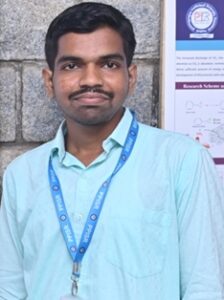
Current PhD students: 1
|
|
Mr. Vijay Shidyal |
Former Students: 15
Former Research Fellow: 1
- Mr. Basavaraj Kumbarageri
Former Project Fellows: 5
- Mr. Magudeshwaran
- Mr. Kaviraj
- Ms. Harshitha C
- Mr. Karthikayan
- Mr. Ganesh N
Former M.Sc. interns’ students: 9
- Ms. Ashritha G
- Mr. Shreesha Govinda K S
- Ms. J. Maneesha
- Ms. Prateeksha V Naik
- Ms. Ranjita R Naik
- Ms. Pavitra M Naik
- Ms. Navitha M. V.
- Ms. Hritujaya Bhowmik
- Ms. Lavanya H. N