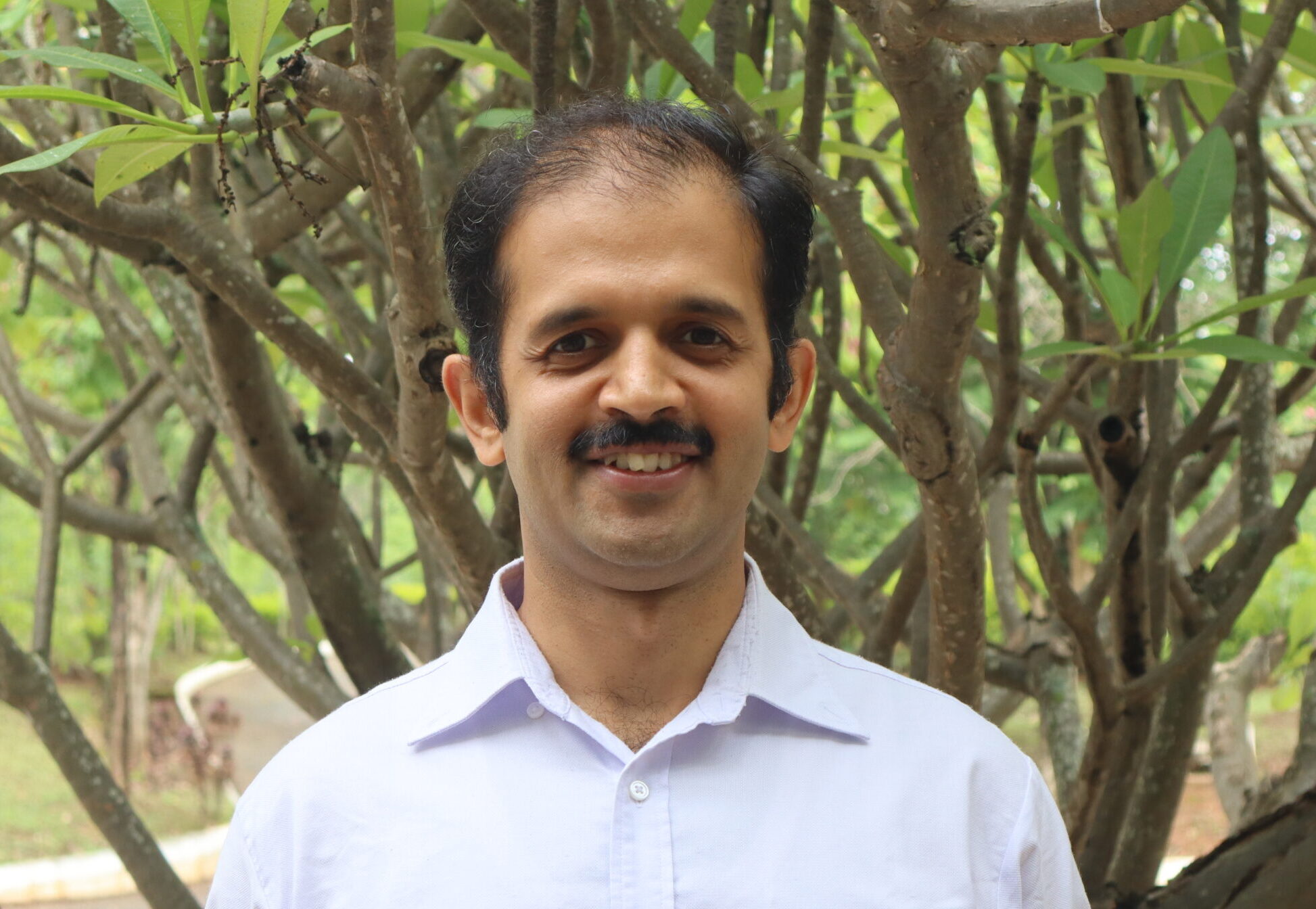
Dr. Kilingaru I Shivakumar
 shivappisr.res.in


03/2025 – present: Assistant Professor, Poornaprajna Institute of Scientific Research (PPISR)
03/2023 – 03/2025: Senior Postdoctoral Researcher, Faculty of Env. Earth Sci., Hokkaido Univ., JAPAN
03/2021 – 03/2023: ICReDD Researcher, ICReDD, Hokkaido University, JAPAN
05/2019 – 03/2021: RIES Postdoctoral Fellow, Res. Inst. for Electronic Sci., Hokkaido University, JAPAN
12/2017 – 04/2019: Postdoctoral Researcher, CBMM, Polish Academy of Sciences, Łódź, POLAND
08/2017 – 11/2017: SERB-National Postdoctoral Fellow, IIT Guwahati, INDIA
01/2011 – 05/2017: PhD, CSIR-National Chemical Laboratory, Pune, INDIA
09/2010 – 12/2010: Visiting Research Student, Raman Research Institute, Bengaluru, INDIA
07/2008 – 05/2010: M.Sc. Chemistry, National Institute of Technology Karnataka, Surathkal, INDIA
05/2009 – 07/2009: Summer Research Intern, IIT Bombay, Mumbai, INDIA
07/2004 – 05/2008: B.Sc.Ed., Regional Institute of Education (NCERT), Mysuru, INDIA
Professional Service
- Peer reviewer for journals published by the Royal Society of Chemistry (J. Mater. Chem. C, RSC Adv.) and the American Chemical Society (ACS Omega).
- Convenor, Indian Scientists Association of Japan (ISAJ) Hokkaido 2024 Symposium, held on Dec 13, 2024, at Hokkaido University, Sapporo, Japan.
- Joint Secretary, Hokkaido and Tohoku Chapter, India Japan Society for Science, Technology & Education (IJSSTE), 2023-2025.
- Delivered invited talks at Sophia University, Tokyo (May 2024) and Embassy of India in Japan, Tokyo (October 2024).
- Member, Chemical Society of Japan (2023-2025).
About AFM Lab
At the Advanced Functional Materials (AFM) Lab, our mission is to explore and develop functional materials for emerging technologies.
We focus on the rational design and synthesis of organic, short- and long-chain polymeric, and metal–organic hybrid molecules for the development of functional materials with precisely tuned structural and physicochemical characteristics.
Our research explores how these tailored molecules self-assemble, adopt defined conformations, or organize into porous frameworks. We investigate the resulting properties in the context of next-generation electronic materials and crystalline porous materials for molecular recognition and selective uptake of guests with a special emphasis on environmental sustainability.
While the areas below reflect some of our core interests, our research is not confined to them.
Donor-Acceptor Charge-Transfer Interactions
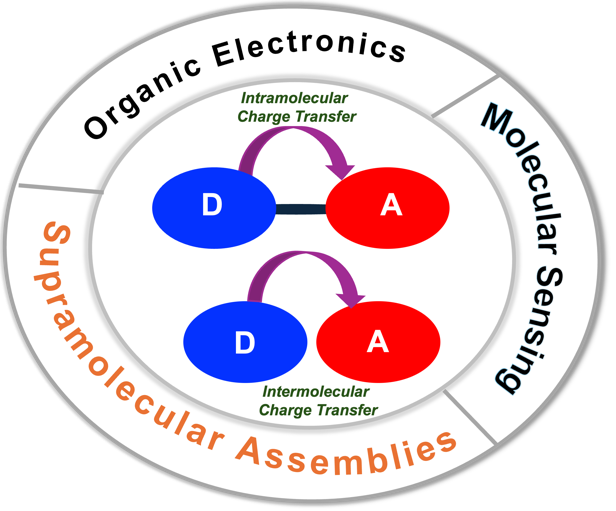 Donor–acceptor (D–A) charge-transfer (CT) interactions are central to the design of wide range of functional organic materials. Depending on the system, these interactions can be intramolecular or intermolecular, and they manifest in solution and/or solid states. They govern key properties such as electroluminescence, ferroelectricity, conductivity, and nonlinear optical response, which arise from charge delocalization, dipole formation, and molecular polarization. By tuning the molecular geometry and the atoms involved in the D–A systems, we aim to develop multifunctional materials with precisely tailored optoelectronic and electronic properties.
Organic Spintronics
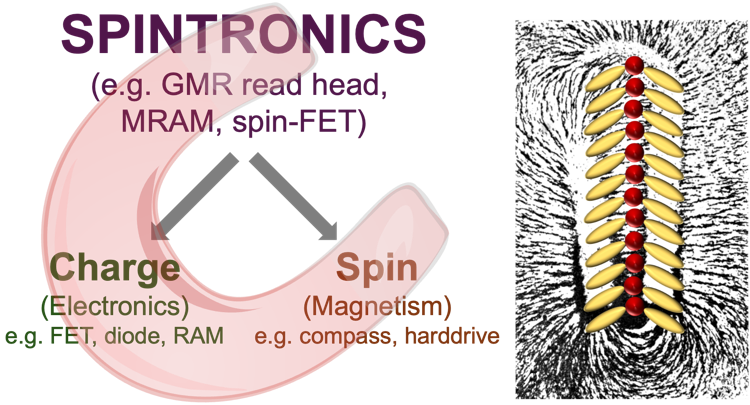 Spintronics harnesses both the spin and charge of electrons to enable low-power, high-speed data processing, efficient storage, and secure communication. Unlike inorganic semiconductors with short spin-relaxation times, organic radicals offer longer spin lifetimes, weak spin-orbit coupling, and extended spin lifetimes. Our goal is to design self-assembling organic radicals that align under magnetic fields, enhancing unidirectional spin and charge transport through macroscopic ordering.
Organic Semiconductors
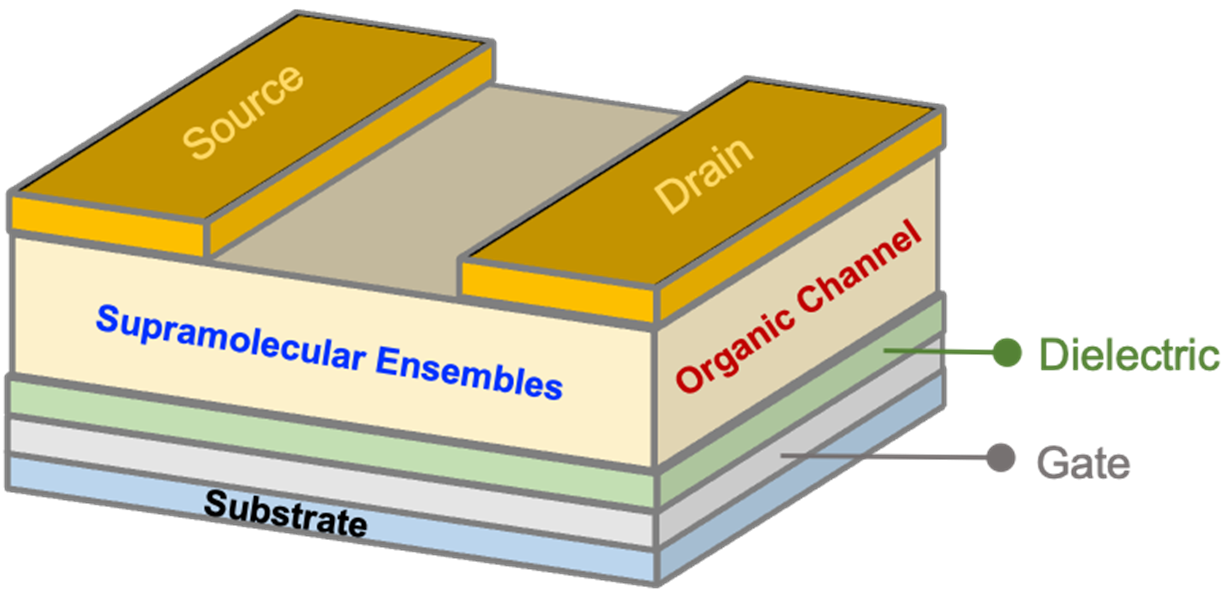 Organic semiconductors are essential for next-generation organic electronic devices. However, the development of n-type materials lags behind p-type counterparts, mainly due to their lower stability under ambient conditions and inferior charge-carrier mobility. This scarcity stems from the limited molecular design strategies that meet the stringent requirements for n-type performance. So, we aim to address this challenge through rational molecular design to enhance electron mobility, ultimately enabling more affordable and energy-efficient organic-based electronic devices.
Soft Porous Crystals
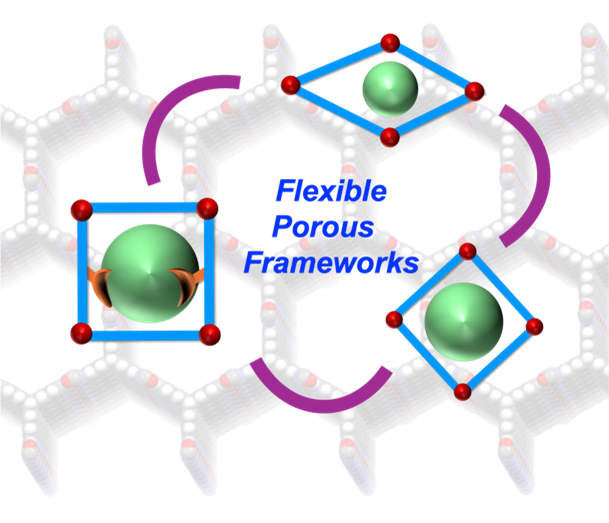 Crystalline porous materials (CPMs) such as metal-organic frameworks (MOFs), covalent organic frameworks (COFs), and hydrogen-bonded organic frameworks (HOFs) offer tunable porosity, high crystallinity, and chemical stability, making them attractive for applications in sensing, gas separation, energy storage, water purification, drug delivery, and catalysis. While MOFs and COFs benefit from robust coordination or covalent bonds, HOFs—constructed via reversible hydrogen bonding—add further advantages such as enhanced solution processability and ease of regeneration. Beyond their static porosity, a promising direction involves developing soft porous crystals—materials capable of reversible structural transformations in response to external stimuli such as guest molecules, light, or electric fields. These dynamic transitions between closed and open forms can greatly enhance material responsiveness and function. However, such behavior has so far been largely limited to specific MOF systems. Expanding this dynamic versatility across different classes of CPMs, including metal-free architectures, presents an exciting opportunity for the development of next-generation adaptive porous materials.
- Title of the project: Direct Air Capture and On-Demand Release of CO2 Using a Light-Swing Mechanism in a Covalent Organic Framework.
Funding Agency: Silver Award, 10th Hokkaido University Interdepartmental Symposium Research Grant, under the Grant for the Promotion Project for Young Investigators, Hokkaido University (2021–2026).
Role: Principal Investigator
Budget: ¥ 600,000
Status: Completed - Title of the project: The Effect of Systematic Induction of Fluorine and Nitrogen on Semiconducting Property of Shape-Persistent Arylene-Ethynylene Macrocycles
Funding Agency: Science and Engineering Research Board (SERB).
Role: Principal Investigator
Budget: ₹ 1,920,000
Status: Completed
- Implementation of Highly Crystalline Polyketones as Solid Polymer Electrolytes in High-Temperature Lithium Metal Batteries
Andersson, R., Johansson, I.L., Shivakumar, K. I., Hernández, G., Inokuma, Y., Mindemark, J. Solid State Ion., 2024, 410, 116542; DOI: 10.1016/j.ssi.2024.116542 - Chain-Length-Dependent Hydrogen-Bonded Self-Assembly of Terminally Functionalized Discrete Polyketones,
Shivakumar, K. I., Manabe, Y., Yoneda, T., Ide, Y., Inokuma, Y. Precis. Chem., 2023, 1, 34-39; DOI: 10.1021/prechem.3c00025 - Determination of the Critical Chain Length for Macromolecular Crystallization of Structurally Flexible Polyketones,
Ide, Y., Manabe, Y., Inaba, Y., Kinoshita, Y., Pirillo, J., Hijikata, Y., Yoneda, T., Shivakumar, K. I., Tanaka, S., Asakawa, H., Inokuma, Y., Chem. Sci., 2022, 13, 9848-9854. (2022 Chem Sci Pick of the week and Front cover); DOI: 10.1039/D2SC03083G - Alkali Metal Ion Binding Using Cyclic Polyketones
Ozawa, N., Shivakumar, K. I., Murugavel, M., Inaba, Y., Yoneda, T., Ide, Y., Pirillo, J., Hijikata, Y., Inokuma, Y., Chem. Commun., 2022, 58, 2971-2974. (Hot article, inside front cover); DOI: 10.1039/D2CC00361A - Hydrogen-Bonded Organic Framework Based on Redox-Active Tri(dithiolylidene) cyclohexanetrione
Shivakumar, K. I., Noro, S-i., Yamaguchi, Y., Ishigaki, Y., Saeki, A., Takahashi, K., Nakamura, T., Hisaki, I. Chem. Commun., 2021, 57, 1157-1160; DOI: 10.1039/D0CC07776C - Photoconductive Bent-Core Liquid Crystalline Radicals with a Paramagnetic Polar Switchable Phase
Shivakumar, K. I., Pociecha, D., Szczytko, J., Kapuscinski, S., Monobe, H., Kaszynski, P., Mater. Chem. C, 2020, 8, 1083-1088; DOI: 10.1039/C9TC05764A - Conducting Nanofibres of Solvatofluorochromic Cyclohexanetrione–Dithiolylidene-Based C3 Symmetric Molecule
Shivakumar, K. I., Goudappagouda, Gonnade, R., Babu, S. S., Sanjayan, G. J., Chem. Commun. 2018, 54, 212-215; DOI: 10.1039/C7CC08741A - Mixed-Stack Charge Transfer Crystals of Pillar[5]quinone and Tetrathiafulvalene Exhibiting Ferroelectric Features
Shivakumar, K. I., Swathi, K., Goudappagouda, Das, T., Kumar, A., Makde, R.D., Vanka, K., Narayan, K. S., Babu, S. S., Sanjayan. G. J., Chem. Eur. J. 2017, 23, 12630-12635. (Hot paper); DOI: 10.1002/chem.201702577 - Exploiting Powder X-ray Diffraction to Establish the Solvent-Assisted Solid-State Supramolecular Assembly of Pillar[5]quinone
Shivakumar, K. I., Yan, Y.; Hughes, C. E.; Apperley, D. C.; Harris, K. D. M.; Sanjayan, G. J., Cryst. Growth Des., 2015, 15, 1583-1587; DOI: 10.1021/acs.cgd.5b00277 - An Easy and Multigram-Scale Synthesis of Pillar[5]quinone by the Hypervalent Iodine Oxidation of 1,4-Dimethoxypillar[5]arene
Shivakumar, K. I., Sanjayan, G. J. Synthesis, 2013, 45, 896-898; DOI: 10.1055/s-0032-1318390 - Synthesis, Characterization and Third-Order Nonlinear Optical Studies of Copper Complexes Containing 1,10-Phenanthroline-5,6-dione and Triphenylphosphine Ligands
Rudresha, B. J., Bhat. B. R., Kumar, H. C. S., Shivakumar, K. I., Safakath, K., Philip, R., Synth. Met. 2011, 161, 535-539; DOI: 10.1016/j.synthmet.2010.12.006
Patents
- Process for the Preparation of Pillar[5]quinone
J. Sanjayan and K. I. Shivakumar
US Patent 9000224, April 7, 2015
- 2025 : Recognition as a PhD supervisor, Manipal Academy of Higher Education (MAHE), Manipal
- 2024 : Silver Award, 10th Hokkaido University Interdepartmental Symposium Research Grant
- 2018 : Vidyarathna Award, Bengaluru
- 2017 : SERB-National Postdoctoral Fellowship
- 2011-2015 : CSIR-UGC Junior and Senior Research Fellowships
- 2010 : Prof. G. U. Kulkarni Gold Medal for securing first rank in M.Sc. Chemistry program
- 2010 : NITK Gold Medal for securing first rank in M.Sc. Chemistry program
| 1 | 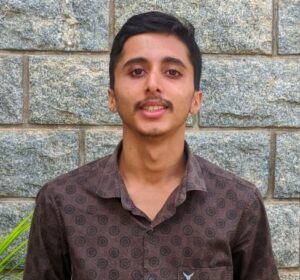 |
Mr. Sudhanva Shyam S. (INSPIRE-SHE Scholar) PhD Scholar (I Year) Research Field: Covalent Organic Frameworks Joining: September 2025 |
The Advanced Functional Materials Lab is a newly established group with the vision of building a vibrant and collaborative research team.
We welcome passionate and motivated individuals interested in pursuing Ph.D. studies or short-term research internships in the areas of functional organic and organic–inorganic hybrid materials, polymers, and their applications in electronics and environmental sustainability.
Prospective candidates are encouraged to contact Dr. Shivakumar with their CV and a brief note describing their research interests.